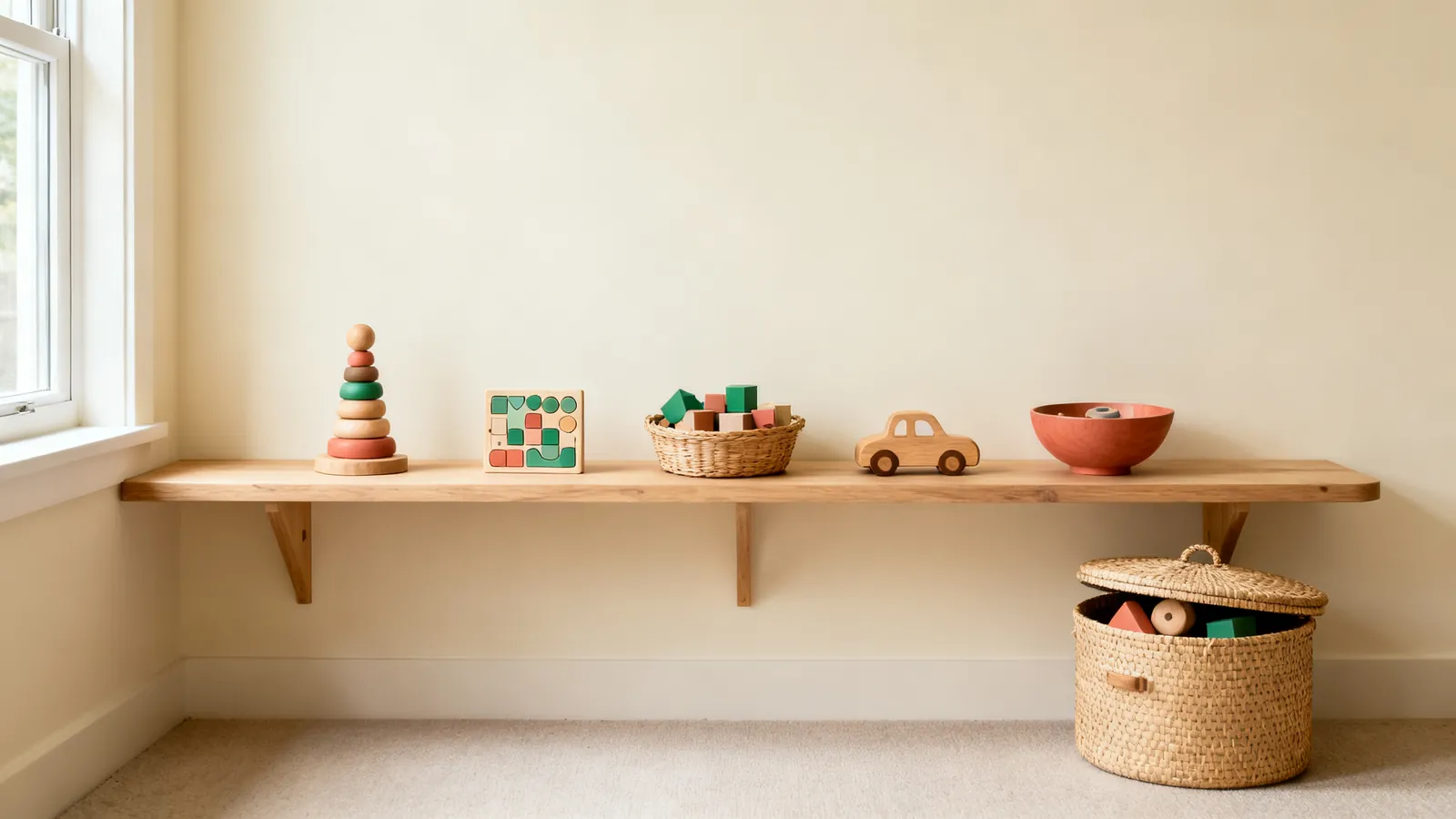
Montessori Toy Rotation: The Minimalist Parent's Guide to Less Clutter, More Learning
As an Amazon Associate we earn from qualifying purchases. Links on this page may be affiliate links. Learn more
Do you ever look at your playroom and feel completely overwhelmed? Toys scattered everywhere, your child bouncing from one thing to another without truly engaging with anything, and you wondering how you accumulated so much stuff?
You're not alone.
This comprehensive guide will show you exactly how to implement toy rotation in your home, regardless of your space or budget.
The Science Behind Toy Rotation
Before diving into the "how," let's understand the "why."
A 2017 study published in Infant Behavior and Development found that toddlers with fewer toys demonstrated:
- Higher quality play - longer engagement periods
- Greater creativity - more imaginative uses for each toy
- Better focus - reduced distraction and deeper concentration
Maria Montessori's Philosophy
Maria Montessori observed that children thrive in environments that are:
- Ordered and beautiful - visual calm supports concentration
- Purposeful - each item has a place and purpose
- Child-sized - accessible and manageable for small hands
Her approach emphasized "freedom within limits" - giving children autonomy while maintaining structure.
The bottom line: Less really is more when it comes to children's toys.
How Many Toys Does a Child Need?
The Montessori answer: Fewer than you think.
By Age Group
These visible counts are a common starting point, not a sourced figure. We use the same scale across this site, including our Montessori shelf guide.
Infants (0-12 months)
- Visible: 3-5 toys at a time
- Total collection: 15-20 toys
- Why: Limited motor skills, high sensory sensitivity
Toddlers (1-3 years)
- Visible: 5-8 toys at a time from 12 to 24 months, 6-10 from 2 to 3 years
- Total collection: 25-35 toys
- Why: Developing focus, learning object permanence
Preschoolers (3-5 years)
- Visible: 8-12 toys at a time
- Total collection: 30-50 toys
- Why: Longer attention spans, more complex play
School Age (5+ years)
- Visible: 8-12 toys at a time, plus big building sets that live outside the rotation
- Total collection: 40-70 toys
- Why: Specialized interests, hobby development
A simple rule of thumb
- Match the number on the shelf to the age scale above
- Keep items separated with visual breathing room
- Rotate every week or two, sooner if something is ignored
Setting Up Your Toy Rotation System
Step 1: Audit Your Current Toy Collection
Block out 2-3 hours for this important process.
What You'll Need:
- Large boxes or bins
- Labels and marker
- Notebook for observations
- Your child's input (if age-appropriate)
The Process:
-
Gather everything - Collect ALL toys from every room
-
Categorize by type:
- Practical life (dishes, cleaning tools, dress-up)
- Sensorial (puzzles, stacking, matching)
- Language (books, alphabet toys, story props)
- Mathematics (counting, sorting, patterns)
- Creative (art supplies, music, building)
- Gross motor (balls, climbing toys, ride-ons)
-
Evaluate each toy using the 4-Test:
Keep if:
- ✅ Child uses it regularly (in past month)
- ✅ Developmentally appropriate
- ✅ Open-ended (multiple uses)
- ✅ Safe and in good condition
Donate/discard if:
- ❌ Broken or missing pieces
- ❌ Outgrown or too advanced
- ❌ Purely electronic/passive entertainment
- ❌ Duplicates or excessive quantity
- Create three piles:
- Active Rotation (keep visible)
- Storage Rotation (rotate in later)
- Remove (donate, sell, trash)
Step 2: Organize Your Storage System
Effective storage makes rotation effortless.
Option 1: The Bin Method
Perfect for: Small spaces, shared rooms, frequent movers
What You Need:
- 3-4 large storage bins
- Labels (Rotation A, B, C, D)
- Shelf or closet space
How It Works:
- One bin stays out (active toys on shelf)
- Other bins stored in closet
- Swap bins every week or two, sooner if something is ignored
Recommended Products:
Option 2: The Category Method
Perfect for: Larger spaces, multiple children, varied interests
What You Need:
- Category-specific storage (baskets, bins, shelves)
- Visual labels (pictures + words)
- Inventory list
How It Works:
- Store categories separately (puzzles, blocks, dolls)
- Rotate items within each category
- Maintain balanced selection across categories
Recommended Products:
Option 3: The Closet System
Perfect for: Dedicated playrooms, large collections, organization enthusiasts
What You Need:
- Closet with shelving
- Clear containers or bins
- Inventory spreadsheet
How It Works:
- Designate closet for toy storage
- Label shelves by category or rotation set
- Track rotation schedule digitally
Recommended Products:
Step 3: Create Your Rotation Schedule
The Montessori Answer: "It depends."
The true answer to "how often should I rotate toys?" is based on observation of your child.
Signs It's Time to Rotate:
Rotate When You Notice:
- ✓ Toys ignored for 3+ consecutive days
- ✓ Repetitive play without new discoveries
- ✓ Requests for "something new"
- ✓ Decreased engagement time
- ✓ More mess, less purposeful play
Keep Current Rotation When:
- ✗ Deep, focused play occurring
- ✗ New skills being mastered
- ✗ Toys used in creative, new ways
- ✗ Child content and engaged
A starting schedule
Start with every week or two, sooner if something is ignored, then adjust to what you see.
- Under 2: swap two or three items at a time rather than the whole shelf.
- Ages 2 to 4: pick a fixed day, such as every other Monday, so it actually happens.
- Preschoolers in the middle of a long project: leave that toy out until they're done. The schedule is a default, not a rule.
The Perfect Montessori Toy Shelf Setup
How you display toys matters as much as which toys you display.
The 8 Principles of Montessori Shelf Arrangement
1. Low and Accessible
- Shelves at child's eye level (18-36 inches high)
- No climbing or adult assistance needed
2. Everything Visible
- No toy boxes (children can't see what's inside)
- Each toy clearly visible from standing position
3. Breathing Room
- 2-4 inches between each toy
- Visual calm, not overwhelming clutter
4. Left to Right, Top to Bottom
- Simplest toys on left, complex on right
- Mirrors reading progression
- Supports cognitive development
5. Trays and Containers
- Each toy on individual tray or in basket
- Clear boundaries for each activity
- Easy cleanup (everything returns to tray)
6. Complete Activities
- All pieces together (puzzle with pieces, blocks with container)
- Frustration-free access
- Encourages independence
7. Beauty and Order
- Aesthetically pleasing arrangements
- Natural materials when possible
- Neat, organized appearance
8. Rotation Station
- One designated "new" spot on shelf
- Introduces rotated item with fanfare
- Child knows where to look for novelty
Sample Shelf Layouts by Age
Infant Shelf (6-12 months)
On the shelf (3–5 items at a time):
- Wooden rattle or grasping toy
- Soft fabric book
- Nesting cups
- Object permanence box
Nearby, not on the shelf: a mirror fixed low on the wall, and a push toy once your baby is pulling up (check its age label).
Recommended Shelf:
Toddler Shelf (18-36 months)
On the shelf (5–8 items before age 2, 6–10 from 2 to 3):
- Simple puzzle (3-5 pieces)
- Shape sorter
- Stacking toy
- Musical instrument
- Building blocks (in a basket)
- Pretend play set
- Matching game
- Push/pull toy
Books live in a separate front-facing display. Save lacing beads for later: most sets are labeled 3 and up.
Recommended Shelf:
Preschool Shelf (3-5 years)
Arrange 8-12 items across shelves:
- 2-3 puzzles (increasing difficulty)
- Building materials (blocks, magnet tiles)
- Art station (paper, crayons, scissors)
- Math manipulatives (counting bears, pattern blocks)
- Literacy materials (alphabet puzzle, letter tiles)
- Sensory bin
- Practical life activity (pouring, tweezing)
- Pretend play props
- Science exploration (magnifying glass, nature items)
- Music/movement (instruments, scarves)
Recommended Shelf:
Category-Specific Rotation Strategies
Not all toys should rotate at the same frequency.
Always Available (Never Rotate)
Keep these accessible at all times:
- Books - Rotate titles, but keep library available
- Art supplies - Basic materials (paper, crayons, scissors)
- Blocks/building - Open-ended, always engaging
- Outdoor toys - Bikes, balls, climbing equipment
- Comfort items - Loveys, special blankets
Rotate most often
These lose novelty quickly:
- Puzzles - Solve repeatedly then bore easily
- Matching/memory games - Master then need change
- Sensory bins - Need fresh materials for interest
- Themed play sets - Interest wanes after intensive play
Leave out longer
These hold attention longer, so they can stay out through a few rotations:
- Pretend play props - Costumes, play kitchen items
- Construction toys - Different building sets
- Learning toys - Letter/number activities
- Board games - Age-appropriate games
Store for later
These align with interests or seasons:
- Seasonal items - Holiday-themed toys
- Developmental leaps - Save challenging toys for readiness
- Hobby materials - Craft kits, science experiments
The Montessori Rotation Process: Step by Step
Rotation Day should be intentional and calm, not chaotic.
Before Rotation (2-3 Days Prior)
1. Observe Current Play
- Note which toys are used/ignored
- Watch for new skill development
- Ask child (if verbal) what they'd like to see
2. Check Inventory
- Review stored toys
- Ensure all pieces present
- Clean as needed
3. Plan New Selection Consider:
- Developmental stage
- Skill focus (fine motor, language, math)
- Interest themes
- Season or upcoming events
Rotation Day
Best Timing:
- During nap time (toddlers)
- During school (older kids)
- With child present (if they enjoy process)
The Process:
Step 1: Remove (5 minutes)
- Take rotated-out toys from shelf
- Check for missing pieces
- Clean if necessary
Step 2: Clean Shelf (2 minutes)
- Wipe down all surfaces
- Create fresh, inviting space
Step 3: Arrange New Toys (10 minutes)
- Follow shelf arrangement principles
- Ensure proper spacing
- Verify completeness of sets
Step 4: Introduce (5 minutes)
- Present one "new" item with enthusiasm
- Demonstrate if needed
- Allow exploration
Step 5: Store (5 minutes)
- Put rotated-out toys in storage bin
- Label and date
- Note any missing pieces
Total Time: 25-30 minutes
After Rotation
Days 1-3: Observe
- Note initial reactions
- Watch engagement levels
- Identify immediate favorites
Week 1-2: Assess
- Are all toys being used?
- Is play quality high?
- Any adjustments needed?
Between Rotations: Maintain
- Daily cleanup to maintain order
- Remove broken toys immediately
- Note emerging interests for next rotation
Dealing with Common Toy Rotation Challenges
Challenge 1: "But I Want That Toy!"
The Scenario: Child demands a toy that's currently in storage rotation.
Solutions:
Option A: Firm Boundaries
- "That toy is resting right now. Let's play with what's available."
- Redirect to similar toy on shelf
- Hold firm (develops delayed gratification)
Option B: Flexible Exchange
- "You can have that toy if you choose one to put away."
- Child selects trade
- Teaches decision-making
Option C: Special Request System
- One "special request" per week
- Child must wait until tomorrow
- Gives child agency while maintaining structure
Best Approach: Mix of A and B depending on situation.
Challenge 2: Too Many Toys to Rotate
The Problem: Even after decluttering, you still have 200+ toys.
Solutions:
1. The 1-in-1-out Rule
- Birthday or holiday: new toy means old toy donated
- Maintains constant number
- Prevents re-accumulation
2. Deeper Declutter
- Be honest: does child actually play with it?
- Keep only open-ended, high-quality items
- Take photos of sentimental toys before donating
3. The 90-Day Test
- Store questionable toys separately
- If unused in 90 days, donate
- Guilt-free letting go
4. Toy Library Membership
- Rent toys instead of owning
- Perfect for expensive specialty items
- Natural rotation built-in
Challenge 3: Shared Spaces/Multiple Children
The Scenario: Two kids, different ages, one playroom.
Solutions:
Separate Shelves
- Each child has designated shelf
- Different rotation schedules
- Reduces conflict
Shared Items
- One shelf for communal toys
- Promotes cooperation
- Rotate less frequently (both must agree)
Color-Coding
- Each child assigned a color
- Trays/baskets in their color
- Visual ownership system
Age-Appropriate Sections
- Young child: lower shelves
- Older child: higher shelves
- Clear boundaries
Challenge 4: Grandparents/Gift-Givers
The Problem: Well-meaning relatives buy endless toys.
Solutions:
1. Direct Communication Share your approach:
- "We're practicing toy rotation for focus and learning."
- "We'd love experience gifts instead (zoo membership, class enrollment)."
- "Here's our wishlist of needed items."
2. Gift Redirect Suggest alternatives:
- Books (easier to rotate, educational)
- Art supplies (consumable)
- Outdoor equipment
- Clothing
- College fund contributions
3. Immediate Rotation
- New gift goes out immediately
- Different toy rotates into storage
- Maintains balance
- Child still enjoys new gift
4. One-Toy Birthday Rule
- Child chooses ONE gift to open on birthday
- Rest stored for gradual rotation
- Extends birthday joy for months
Challenge 5: Maintaining Consistency
The Problem: Started strong, but rotation system fell apart.
Solutions:
1. Calendar Reminders
- Set recurring phone reminder
- Treat like important appointment
- 30 minutes blocked on calendar
2. Tie to Existing Routine
- The same weekday every week or two
- Trash or recycling day
- The day you change the sheets
3. Lower Frequency
- If every week feels like too much, go every two weeks
- Less frequent but consistent is better than frequent but abandoned
4. Visual Tracker
- Printable checklist (see below)
- Cross off each rotation
- Satisfying visual progress
5. Enlist Help
- Partner takes some rotations
- Older child helps with process
- Make it a family activity
Printable Toy Rotation Resources
Rotation Tracking Sheet
TOY ROTATION TRACKER

Child's Name: _________________  Age: _______

Current Rotation Dates: _____________ to _____________

CATEGORY | TOY ITEMS (Active)               | ENGAGEMENT LEVEL
---------|----------------------------------|------------------
Practical| 1.                              | ⭐⭐⭐⭐⭐
Life     | 2.                              | ⭐⭐⭐⭐⭐
         | 3.                              | ⭐⭐⭐⭐⭐
---------|----------------------------------|------------------
Sensory  | 1.                              | ⭐⭐⭐⭐⭐
         | 2.                              | ⭐⭐⭐⭐⭐
         | 3.                              | ⭐⭐⭐⭐⭐
---------|----------------------------------|------------------
Language | 1.                              | ⭐⭐⭐⭐⭐
         | 2.                              | ⭐⭐⭐⭐⭐
---------|----------------------------------|------------------
Math     | 1.                              | ⭐⭐⭐⭐⭐
         | 2.                              | ⭐⭐⭐⭐⭐
---------|----------------------------------|------------------
Creative | 1.                              | ⭐⭐⭐⭐⭐
         | 2.                              | ⭐⭐⭐⭐⭐
---------|----------------------------------|------------------

NOTES FOR NEXT ROTATION:
_____________________________________________________________
_____________________________________________________________

DEVELOPMENTAL MILESTONES OBSERVED:
_____________________________________________________________
_____________________________________________________________
Rotation Log
DATE ________   Set A out   Ignored: ______________
DATE ________   Set B out   Ignored: ______________
DATE ________   Set C out   Ignored: ______________
DATE ________   Set A out   Ignored: ______________
DATE ________   Set B out   Ignored: ______________
DATE ________   Set C out   Ignored: ______________
DATE ________   Set A out   Ignored: ______________
DATE ________   Set B out   Ignored: ______________
Quick Audit Checklist
MONTHLY TOY AUDIT CHECKLIST

[ ] Remove broken or damaged toys
[ ] Find missing puzzle pieces
[ ] Wipe down all toys
[ ] Check battery-operated toys
[ ] Organize art supplies
[ ] Refresh sensory bin materials
[ ] Donate outgrown items
[ ] Repair anything fixable
[ ] Update inventory list
[ ] Plan next rotation theme
Advanced Rotation Strategies
Once you've mastered basics, try these advanced techniques:
Theme-Based Rotations
How It Works:
- Choose monthly theme (ocean, transportation, community helpers)
- Rotate in relevant toys
- Add theme-based books
- Coordinate with activities
Example: Ocean Theme
- Blue sensory bin with shells
- Ocean animal figurines
- Fishing game
- Boat building blocks
- Ocean books
Benefits:
- Deeper learning
- Integrated experiences
- Easier parent planning
Skill-Focused Rotations
How It Works:
- Identify developmental focus (fine motor skills)
- Select toys supporting that skill
- Intensive practice period
Example: Fine Motor Focus
- Threading beads
- Tweezers and pompoms
- Playdough with tools
- Stickers and paper
- Scissors and cutting practice
Benefits:
- Rapid skill development
- Targeted support
- Measurable progress
Interest-Led Rotations
How It Works:
- Observe current fascination (dinosaurs, cooking, construction)
- Rotate in items supporting interest
- Ride the wave of motivation
Example: Dinosaur Interest
- Dinosaur figurines
- Excavation kit
- Dinosaur books
- Fossil sensory bin
- Dinosaur puzzle
Benefits:
- High engagement
- Child-directed learning
- Deepens knowledge
Seasonal Rotations
How It Works:
- Align toys with seasons and holidays
- Rotate as seasons change
- Connect play to environment
Fall Example:
- Leaf sorting activity
- Apple counting game
- Pumpkin sensory bin
- Fall nature basket
- Harvest-themed books
Benefits:
- Relevant to child's experiences
- Natural rhythm
- Reduces storage needs
Toy Rotation Beyond the Playroom
Bedroom
Bedtime Book Rotation
- Keep 5-8 books visible
- Swap a few when interest wanes
- Store rest in closet
Recommended:
Bathroom
Bath Toy Rotation
- 3-5 toys in bath at a time
- Rotate weekly (prevents mold)
- Store in mesh bag
Recommended:
Car
Travel Toy Rotation
- Keep 2-3 quiet activities in car
- Swap when they stop getting used
- Store in car organizer
Recommended:
Restaurant/Waiting Bag
On-the-Go Entertainment
- Small busy bag with 3-4 items
- Rotate after each use
- Stays fresh and exciting
Recommended:
Minimalist Toy Lists by Age
These curated lists represent the essential toys needed for each age, following strict minimalist and Montessori principles.
Minimalist Infant Toy List (0-12 Months)
Total: 15 Toys
Sensory (5 items):
Motor Development (5 items): 6. Wooden teether 7. Nesting cups 8. Stacking rings 9. Push/pull toy 10. Soft blocks
Learning (5 items): 11. Object permanence box 12. Simple shape sorter 13. Board books (set) 14. Musical shaker 15. Basket with scarves
Keep Visible: 3-5 | Rotate: Every week or two
Minimalist Toddler Toy List (1-3 Years)
Total: 30 Toys
Practical Life (5 items):
- Play kitchen set (basic)
- Cleaning set (broom, dustpan)
- Pouring activity
- Dress-up clothes (minimal)
- Play food set
Sensory (6 items): 6. Playdough with tools 7. Sensory bin + fillers 8. Water play toys 9. Musical instruments (2-3) 10. Textured balls 11. Color matching activity
Language (4 items): 12. Board books (10-15) 13. Simple puzzles (4-6 pieces) 14. Naming cards 15. Picture matching game
Math/Logic (4 items): 16. Shape sorter 17. Stacking toy 18. Counting bears or similar 19. Pattern blocks
Creative (6 items): 20. Building blocks (wooden) 21. Crayons and paper 22. Magnetic tiles (small set) 23. Threading toy 24. Duplo or similar large blocks 25. Art supplies (washable)
Gross Motor (5 items): 26. Ball collection 27. Push toy or ride-on 28. Climbing toy (if space) 29. Tunnels/tents 30. Balance board
Keep Visible: 5-8 (12-24 months), 6-10 (2-3 years) | Rotate: Every week or two
Minimalist Preschool Toy List (3-5 Years)
Total: 40 Toys
Practical Life (5 items):
Sensory (5 items): 6. Sensory bin variety 7. Kinetic sand 8. Water beads 9. Musical instruments set 10. Light table activities
Language (6 items): 11. Picture books (25+) 12. Alphabet puzzle 13. Letter tiles or magnets 14. Phonics game 15. Story sequencing cards 16. Rhyming game
Math (6 items): 17. Counting toys (multiple types) 18. Pattern blocks 19. Tangrams 20. Balance scale 21. Number puzzles 22. Math manipulative set
Creative/Art (8 items): 23. Advanced building blocks 24. Magnetic tiles (expanded) 25. Lego or similar 26. Art easel 27. Quality art supplies 28. Marble run 29. Train set 30. Construction vehicles
Puzzles/Games (6 items): 31. Puzzles (variety, 12-48 pieces) 32. Memory game 33. Matching games 34. Simple board games 35. Lacing cards 36. Geoboard
Science/Nature (4 items): 37. Magnifying glass 38. Bug catcher kit 39. Simple science experiments 40. Nature exploration kit
Keep Visible: 8-12 | Rotate: Every week or two
Toy Rotation FAQs
How do I start toy rotation if I'm completely overwhelmed?
Start small. Don't try to organize everything at once:
Week 1: Just remove obviously broken/outgrown toys Week 2: Create one storage bin and rotate out 5 toys Week 3: Add one more category to rotation Week 4: Set a reminder to rotate every week or two
Progress over perfection.
What if my child has a favorite toy they want available always?
That's perfectly fine! Toy rotation isn't about deprivation. Keep 2-3 absolute favorites permanently accessible. Rotate everything else around them.
Should I rotate toys without my child knowing?
Depends on age and temperament:
Rotate during sleep/school (without child present) if:
- Child is very young (under 2)
- Transitions are difficult
- Strong attachment to everything
Include child in process if:
- Age 3+
- Enjoys organizing
- Can handle decision-making
- Benefits from agency and control
How many rotation sets should I have?
Minimum: 2 sets (one out, one stored) Ideal: 3-4 sets (allows longer time before toys repeat) Maximum: 6 sets (more gets too complex)
Most families find 3 sets works perfectly.
Can I rotate books?
Yes! Books are perfect for rotation. Keep 8-12 books visible, store the rest. Exception: let child keep 2-3 absolute favorite books permanently available.
What about toys from grandparents/gifts?
Option 1: Immediately rotate into storage, bring out later Option 2: Exchange - new gift comes out, different toy goes to storage Option 3: Honest conversation about your system (see Challenge #4 above)
My child loses interest in toys after one day. Should I rotate more frequently?
Possibly, but first check:
- Are toys developmentally appropriate?
- Is environment too stimulating (too many choices)?
- Is toy quality high (open-ended, engaging)?
- Are YOU modeling focused play?
Try rotating every 3-4 days initially, then extend as focus improves.
How do I handle small pieces across multiple sets?
System 1: Ziploc bags labeled with toy name System 2: Small tackle box with compartments System 3: Individual containers for each toy's pieces
Never separate pieces from main toy during storage.
Should outdoor toys rotate?
Generally no. Outdoor toys (bikes, balls, climbing equipment) should stay accessible. Exception: seasonal toys (sleds, water tables) rotate naturally with weather.
What's the best way to store rotated toys?
Depends on space:
- Closet: Best option, out of sight
- Under bed: Space-saving, use flat bins
- Garage: Climate-controlled area only
- Basement: Avoid if damp (damages wooden toys)
- Storage unit: Only if absolutely necessary
Always use closed containers to prevent dust/damage.
Conclusion: The Life-Changing Magic of Less
Toy rotation isn't just about organization—it's a fundamental shift in how we approach childhood, learning, and consumption.
By implementing toy rotation, you're teaching your child:
- Focus and concentration - depth over breadth
- Resourcefulness - creativity within limits
- Care and responsibility - appreciation for belongings
- Delayed gratification - not everything available immediately
- Environmental consciousness - less consumption, more intention
You're giving yourself:
- Less clutter and stress
- Easier cleanup - 5 minutes instead of 30
- Lower toy costs - buy less, appreciate more
- More meaningful play - quality time over quantity
- Sustainable lifestyle - model values you believe in
Your 30-Day Toy Rotation Challenge
Ready to transform your playroom and your child's play?
Week 1: Audit
- Gather all toys
- Categorize and evaluate
- Ruthlessly declutter
Week 2: Organize
- Create storage system
- Set up Montessori shelf
- Establish first rotation
Week 3: Observe
- Watch play patterns
- Note engagement levels
- Adjust as needed
Week 4: Establish Rhythm
- Set rotation schedule
- Create tracking system
- Celebrate success!
Start Your Toy Rotation Journey:
Remember: The goal isn't perfection. It's progress toward calmer, more focused, more joyful play.
Less clutter. More learning. Happier kids. Saner parents.
That's the power of toy rotation.
Related Articles: