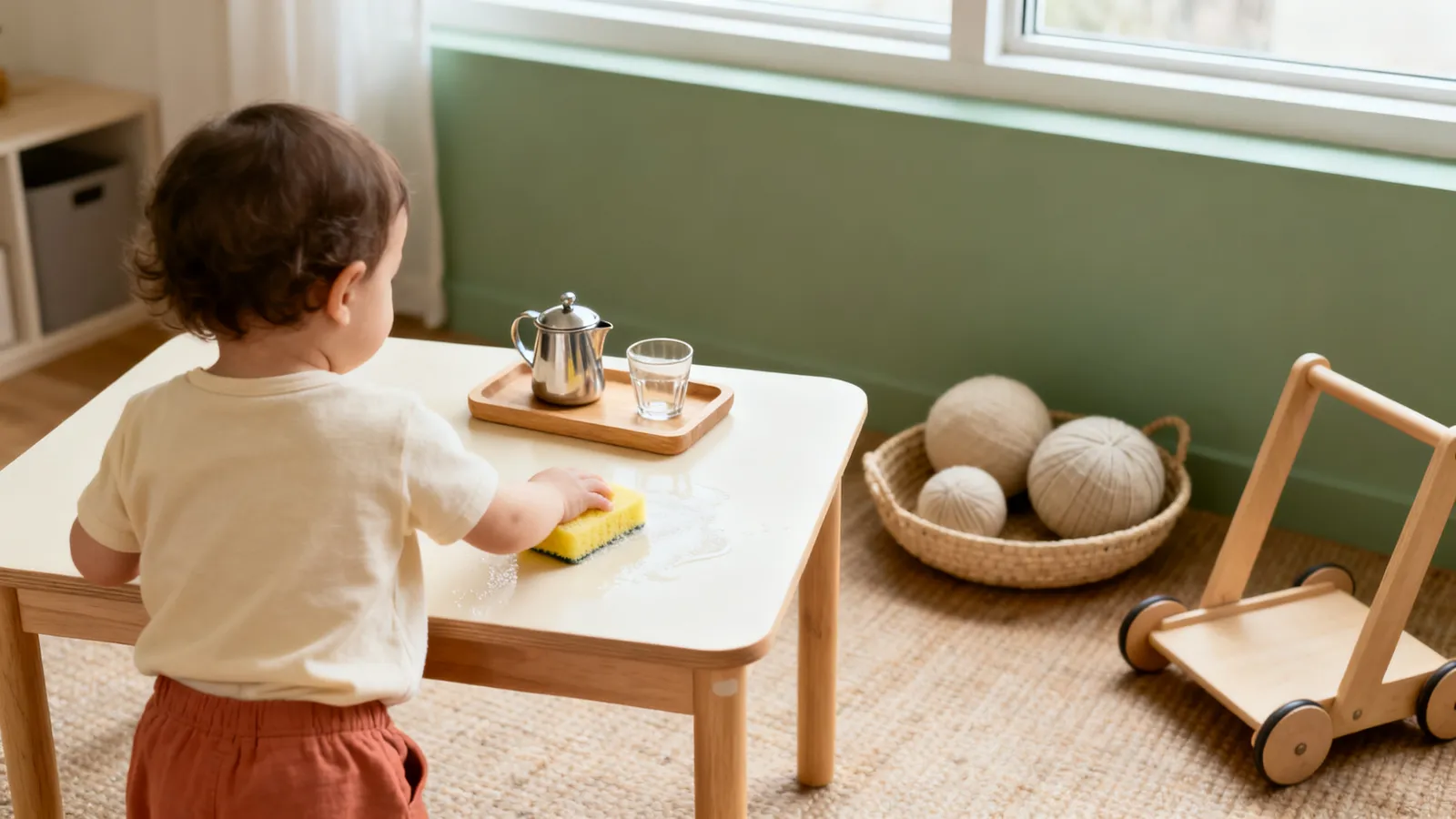
Montessori Activities for 1-Year-Olds: 20 Simple Ideas
As an Amazon Associate we earn from qualifying purchases. Links on this page may be affiliate links. Learn more
Quick answer: The best Montessori activities for 1-year-olds use real, child-sized objects: wiping a table with a sponge, posting a ball into an object permanence box, carrying a basket, pushing a weighted walker, opening and closing lidded boxes, and simple supervised water pouring. Keep five to eight on a low shelf, with two or three your child is working on now, and let them repeat.
Most of what a one-year-old needs is already in your kitchen. The list below is built from things a parent can set up in five minutes, grouped the way Montessori guides group work at this age: practical life, sensory exploration, fine motor (hands) and gross motor (whole body). Each one has a materials list and a note on how to make it easier or harder.
Ages are rough. "12 months" and "18 months" describe very different children, and your child may be ready for something earlier or later. Watch what they keep returning to and follow that.
Where we suggest a product, we research manufacturer listings, specs, age and safety labels, and buyer reviews. We don't test products hands-on.
The activities at a glance
| Activity | Area | What you need | Usually fits |
|---|---|---|---|
| Wiping the table | Practical life | Small sponge, shallow bowl of water, towel | 12 months + |
| Carrying a basket | Practical life / gross motor | Small basket with a handle, 2 to 3 board books | 12 months + |
| Laundry into the basket | Practical life | Low laundry basket, socks and washcloths | 12 months + |
| Drinking from an open cup | Practical life | Small glass or steel cup, a little water | 12 months + |
| Watering a plant | Practical life | Small watering can, sturdy potted plant | 15 months + |
| Washing fruit | Practical life | Dishpan, a little water, apples or potatoes | 15 months + |
| Treasure basket | Sensory | Basket of large natural and household objects | 12 months + |
| Water pouring | Sensory | Two small pitchers or cups, tray, towel | 15 months + |
| Texture bag | Sensory | Fabric scraps, a brush, a wooden spoon | 12 months + |
| Ball posting | Fine motor | Object permanence box or a tub with a hole | 12 months + |
| Lids on, lids off | Fine motor | Two or three lidded containers, one large toy | 12 months + |
| Single-peg stacker | Fine motor | Ring stacker with large rings | 12 months + |
| Stick posting | Fine motor | Jumbo craft sticks, container with a slot | 15 months + |
| Knob puzzle | Fine motor | Puzzle with 1 to 3 large knobbed pieces | 15 months + |
| Pushing a walker | Gross motor | Wooden push walker with weight in the tray | Pulling to stand + |
| Ball rolling and kicking | Gross motor | Soft ball, larger than a fist | 12 months + |
| Climbing | Gross motor | Low step, couch cushions or a climbing triangle | 12 months + (triangle labels start between 10 and 36 months; check yours) |
| Crawl tunnel | Gross motor | Kitchen chairs and a sheet, or a play tunnel | 12 months + |
| Naming real objects | Language | Three real objects in a basket | 12 months + |
| Book basket | Language | 3 to 5 board books facing out | 12 months + |
How to offer an activity
At this age, how you hand an activity over counts as much as the materials:
- Show it once, slowly, with few words. Sit beside your child, do the activity yourself at half speed, then step back.
- Let them choose. Keep five to eight things on a low Montessori shelf, a common starting point at this age, and let your child pick. Put the others away for now.
- Guide instead of correcting. If the water ends up on the floor, hand over the towel. The mess is part of the work.
- Give them time. Repetition is the point. A child who posts the same ball twenty times is still working.
- Notice what they return to. A few notes on your phone each week tell you what to keep out and what to rotate. The toy rotation guide covers how to swap things in and out.
- Stay close. Every activity below assumes an adult nearby, and the water and climbing ones need you within arm's reach.
Practical life activities
Practical life means the everyday tasks a child sees adults doing. One-year-olds tend to love them because they are real. For more ideas once your child is walking steadily, see our guide to practical life skills in the kitchen.
1. Wiping the table
Materials: a small sponge or cut-down kitchen sponge, a shallow bowl with a little water, a hand towel.
Show your child how to dip, squeeze and wipe the low table. At first they will mostly squeeze the sponge, and that is fine; squeezing is hand work too. Later, add a dry cloth to finish. Empty the bowl when you are done so no water is left standing.
2. Carrying a basket
Materials: a small basket with a handle, two or three board books or a soft toy.
New walkers love carrying things. Ask your child to bring the basket from the shelf to the rug, or help carry the napkins to the table. Carrying something while walking asks for a little more balance than walking empty-handed.
3. Laundry into the basket
Materials: a low laundry basket and a pile of clean socks and washcloths.
Sit on the floor with the clean laundry and put items into the basket one at a time. Your child will copy. At 18 months and up, try sorting: your socks in one basket, theirs in another.
4. Drinking from an open cup
Materials: a small cup your child can hold in two hands (steel, or small glass or ceramic only at the table with you), a tablespoon or two of water, a cloth for spills.
Many Montessori families introduce an open cup at meals from around a year. Put in only a little water at a time. Expect spills, and keep the cloth within reach so your child can help wipe up.
5. Watering a plant
Materials: a small watering can, one sturdy, non-toxic potted plant, a tray under the pot.
Fill the can with a little water so the plant isn't flooded. This becomes a daily job your child can own. Check that the plant is safe if leaves get chewed; many common houseplants are not.
6. Washing fruit
Materials: a dishpan with a little water in the bottom, a few apples or potatoes, a vegetable brush, a towel.
Set it up on the floor on a towel or at a low table. Your child scrubs, you dry. Stay right there for this one (see the water safety note below).
Sensory activities
7. Treasure basket
Materials: a low basket with six to eight objects of different textures and weights: a wooden spoon, a large wooden ring, a metal measuring cup, a silicone whisk, a small stainless steel bowl.
Let your child pull things out, mouth them, bang them together and put them back. Swap one or two objects every few days. Every object should be clean, too large to swallow, and without loose parts.
8. Water pouring
Materials: a tray with a raised edge, two small cups or a small pitcher and a cup, a little water, a towel.
Skip the dry-pouring versions you see online; beans, rice and pasta are choking hazards at this age. Pour from the pitcher into the cup and back while your child watches, then let them try. Most of it will spill at first. Keep the water level low and stay within arm's reach.
9. Texture bag
Materials: a cloth bag holding a few different fabrics (wool, corduroy, satin), a soft brush and a wooden spoon.
Pull out one item at a time and name it: "soft," "bumpy," "smooth." Your child will reach in for the next one. This is as much a language activity as a sensory one.
Fine motor activities
10. Ball posting
Materials: an object permanence box, or a lidded tub with a hole cut in the lid and a ball at least 1.75 inches (44 mm) across, the federal small-ball limit for toys for children under 3.
The child drops the ball through the hole; it vanishes, then reappears in the tray or when the lid comes off. It is one of the classic Montessori materials for the end of the first year and into the second. If you'd rather buy than make one, the Adena box below has over 2,000 Amazon ratings and is labeled for 6 to 32 months; the listing doesn't state the size of its three wooden balls, so measure them before first use: each should be at least 1.75 inches across. If you'd rather not measure, pick a box whose listing states the ball size. Count the balls back in after play.

Price incl. tax, excl. shipping. Updated 2026-10-02.
11. Lids on, lids off
Materials: two or three containers with easy lids (a small box with a hinged lid, a jar with a wide screw-top, a tin with a lift-off lid) and one large toy to hide inside.
Hide the toy, close the lid, and hand it over. Start with lift-off lids, then hinged, then a wide screw-top later in the second year.
12. Single-peg stacker
Materials: a ring stacker with one straight peg and large rings.
At first your child will take the rings off. Putting them back on comes later. A straight peg with rings of similar size works better at this stage than a cone-shaped stacker that needs size order. Our toys for 1-year-olds guide has stacker picks.
13. Stick posting
Materials: a container with a slot cut in the lid, and five or six jumbo craft sticks.
Pushing a flat stick through a narrow slot asks for more aim than a ball through a round hole. Count the sticks in and out so none go missing.
14. Knob puzzle
Materials: a wooden puzzle with one to three large pieces with big knobs.
Choose shapes that are easy to tell apart, like a circle, square and triangle. More pieces can wait until the simple version gets easy.
Gross motor activities
15. Pushing a walker
Materials: a sturdy wooden push walker. Put a few board books in the tray if it rolls away too fast.
For children who are pulling to stand or taking first steps, a walker that is weighted and slow gives them something stable to push. Use it on a flat floor, away from stairs. If you buy one, look for adjustable wheel resistance. The Tiny Land walker below lists a built-in speed control and rubber wheels; the activity panel on the front is extra, and a plain walker works just as well. The listing gives no age range, so use it once your child pulls to stand, with you close by.

Price incl. tax, excl. shipping. Updated 2026-10-02.
16. Ball rolling and kicking
Materials: a soft ball bigger than your child's fist.
Sit facing each other with your legs apart and roll it back and forth. Once your child walks, set the ball down and show them how to kick it.
17. Climbing
Materials: a low step stool, a pile of couch cushions on the floor, or a climbing triangle.
One-year-olds climb whatever is there. Giving them a safe place to do it is easier than stopping them. If you want dedicated equipment, our Montessori climbing set guide compares triangles, arches and foam blocks, with weight and age ratings.
18. Crawl tunnel
Materials: a sheet draped over two kitchen chairs, or a fabric play tunnel.
Crawl through first and call from the other side. Many one-year-olds who walk still enjoy crawling.
Language activities
19. Naming real objects
Materials: a small basket with three real objects from one category, such as a banana, an apple and an orange, or a cup, a spoon and a bowl.
Hold up each object and name it clearly: "banana." Later, ask "Can you give me the spoon?" Keep it short and stop while your child is still interested.
20. Book basket
Materials: three to five board books with clear, realistic pictures, stored facing out in a basket or on a front-facing rack.
Rotate books like toys. Books showing real photos of animals, food and everyday things fit this age well.
A sample shelf and day
You don't need all twenty. A shelf for a 15-month-old might hold: the object permanence box, a single-peg stacker, a two-piece knob puzzle, a lidded box with a toy inside, the treasure basket and a basket of three books. That's six things. Water pouring and table washing come out at a set time with you, then go back.
A rough daily rhythm that works for many families:
- Morning: free play at the shelf while you are nearby; practical life at breakfast (open cup, wiping up).
- Midday: outside or gross motor time: walking, climbing, ball.
- Afternoon: a water or washing activity with you; laundry or watering the plant.
- Evening: book basket and naming objects.
If you're setting up the space from scratch, the Montessori shelf guide covers shelf height and how many items to put out, and the budget Montessori room setup shows how to do the whole room cheaply. Looking for a present instead? See Montessori gifts for 1-year-olds.
Safety at this age
Two hazards come up again and again with one-year-olds: choking and water.
Choking. The American Academy of Pediatrics lists coins, marbles, small balls, balloons, pen caps, button batteries and toys with small parts as household choking hazards for young children (HealthyChildren.org, AAP). That rules out a lot of popular "Montessori" activities written for preschoolers: pom-pom transfers, bead stringing, dried-bean pouring and coin-drop games with real money. A coin box made for this age, with coins about 1.75 inches across, is the safer version; stay close anyway. Check every object in a treasure basket, follow the age label on anything you buy, and treat anything small enough to fit in your child's mouth as off-limits.
Water. The AAP notes that young children can drown in as little as an inch or two of water, and recommends "touch supervision", staying within arm's length, whenever a child is in or near water (HealthyChildren.org, AAP). For pouring and washing activities, use a small amount of water, stay beside your child the whole time, and empty every container when you finish.
Also: tape, string and ribbon only with you right there; no cords longer than a few inches; and anchor any shelf or furniture your child can climb.
FAQ
What Montessori activities can I do with my 1-year-old?
Start with practical life and posting activities: wiping a table, carrying a basket, drinking from an open cup, posting a ball into a box, and opening and closing lidded containers. Add a push walker and a safe place to climb for gross motor play.
How many activities should a 1-year-old have out at once?
Five to eight on a low shelf is a common starting point, with two or three that your child is working on right now. Fewer choices make it easier for a young child to pick one and stay with it. Rotate every week or two, sooner if something is ignored or mastered.
Is 1 too young for Montessori practical life activities?
No. Montessori homes often start simple practical life, like drinking from an open cup and helping wipe up, around the first birthday. Keep the tasks short, use real child-sized objects, and expect it to be messy for a while.
What are good Montessori activities for an 18-month-old?
Around 18 months, many children are ready for slightly harder versions: a screw-top lid, a three-piece knob puzzle, sorting laundry by owner, washing fruit, watering a plant every day and carrying heavier things. Follow what your child keeps choosing rather than the calendar.
Do I need to buy Montessori materials for these activities?
No. Most of the twenty activities above use things you already own. An object permanence box, a push walker and a simple stacker are the most common purchases, and each has a homemade version.
Are Montessori activities safe for a 1-year-old?
They are when the objects are too large to swallow, water activities are fully supervised, and you follow the age label on anything you buy. Skip activities written for older children that use beads, pom-poms, dried beans or real coins; a coin box made for this age, with coins about 1.75 inches across, is the exception.